
The best daily deduction game in 2026 depends on the skill you want to train: Daily Holmes for visual scene deduction, Murdle for logic grids, Clues by Sam for testimony. All three are free and play in a browser.
In brief
- Daily Holmes, Murdle, and Clues by Sam lead the daily deduction genre, and each trains a different reasoning skill.
- Daily Holmes uses visual evidence and rotates through written deductions and structured interactions.
- Every game reviewed here offers a free browser-playable daily puzzle, though paid extras and access rules vary.
The daily puzzle format that Wordle popularized in 2022 has spread far beyond word games. A growing number of daily games now challenge deductive reasoning, pattern recognition, and logical thinking. Some use text clues, some use logic grids, and some use visual scenes.
This is a curated list of the best daily deduction and logic games available in 2026, each reviewed for what it tests, what it does well, and where it falls short. We include ourselves (Daily Holmes) in the list because this is a genuine comparison, not a marketing page. Every game here is free and playable in a browser.
Visual and reasoning games
Daily Holmes
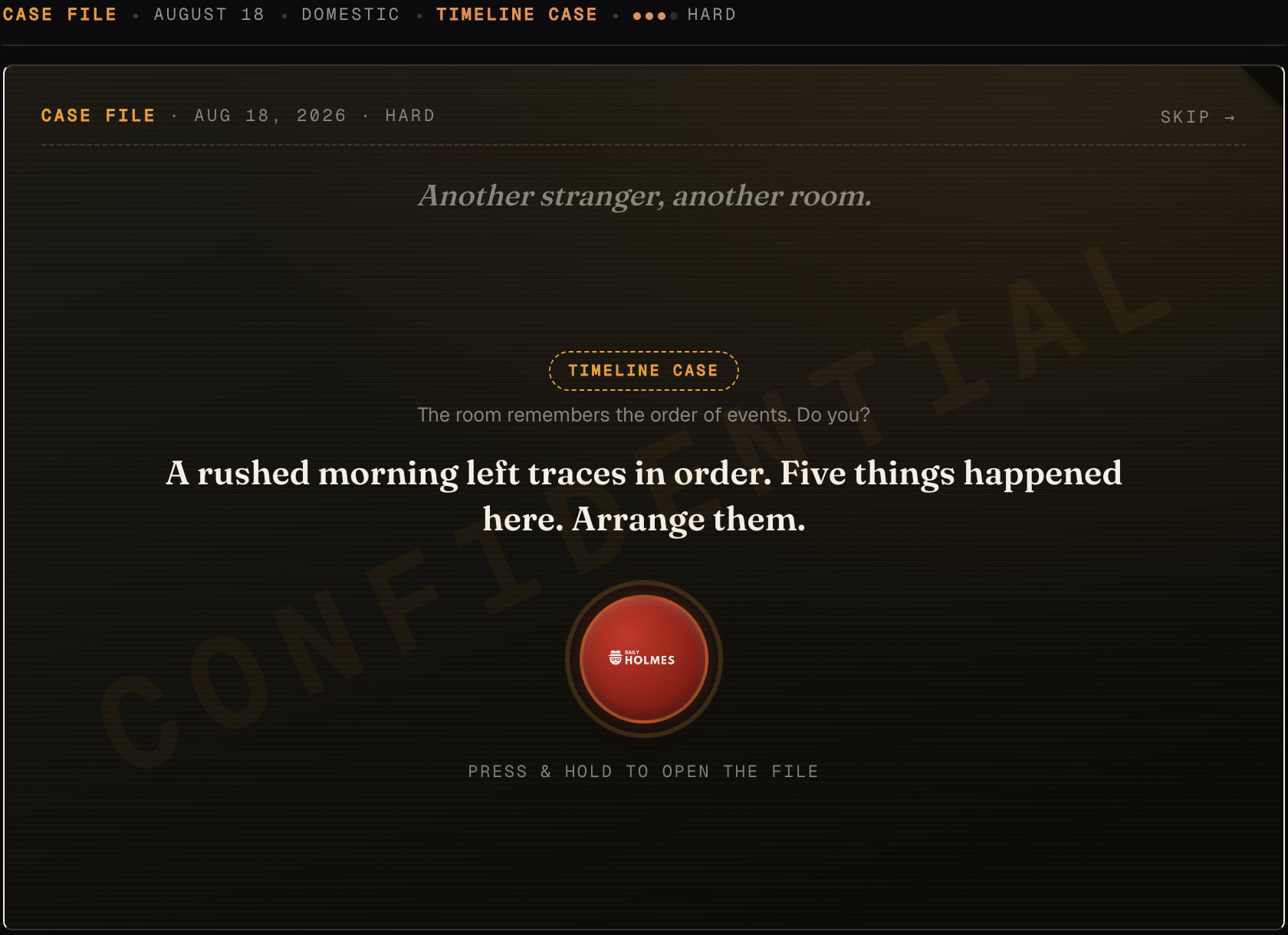
What it is: One visual scene case in the day's interaction format. You might write a deduction, hunt for a clue, identify a false statement, match evidence, or order events. Written deductions receive AI feedback; structured modes are checked deterministically.
Strength: It makes you extract clues from a scene before reasoning from them. Written cases reward a supported argument, while structured cases provide an exact result.
Limitation: AI feedback on written cases is probabilistic and can miss a valid interpretation. The visual format also asks for a different kind of attention than a compact logic grid.
Murdle
What it is: A daily murder mystery by G. T. Karber, running since 2022, presented as a short narrative with suspects, weapons, and locations. You fill in a logic grid to deduce who committed the crime, with what weapon, and where.
Strength: Excellent puzzle design. The logic grid format is clean and satisfying, and G. T. Karber's writing is witty and consistent. The game spawned a bestselling book series that took the UK Christmas number one spot in 2023, a measure of how well the formula travels.
Limitation: Pure text and logic. No visual component, and no feedback on how you reasoned, only on the grid. The format means there is exactly one correct solution found through elimination, which is satisfying but different from the open-ended reasoning of visual deduction.
Clues by Sam
What it is: A daily logic puzzle by Finnish game designer Johannes Ahvenniemi, launched in May 2025. Twenty suspects stand in a 4x5 grid; you read their statements and mark each one criminal or innocent, chaining confirmations and contradictions.
Strength: Every move must be a provable deduction: the game does not let you convict on a hunch, and there is always a logical next step. Difficulty climbs through the week, the community on Reddit is active and helpful, and by early 2026 the game had passed 50,000 daily players.
Limitation: No visual element, and the strict logic means there is one provable path rather than open-ended reasoning. Feedback on a wrong move is minimal.
Detecto
What it is: A daily mystery where you read a short scenario and ask yes/no questions, on a limited budget, to uncover the key facts and solve the case.
Strength: A tight, fast deduction loop. The yes/no questioning trains hypothesis narrowing, and the daily reset keeps it a quick ritual.
Limitation: Text-only, no visual element, and limited feedback on the path you took to the answer.
Mystery-o-matic
What it is: A daily auto-generated murder mystery you solve in about five minutes by reasoning over the generated clues.
Strength: Endless variety from procedural generation, and a fast, low-commitment daily.
Limitation: Procedural generation means cases lack the authored character of a hand-written mystery, and the presentation is minimal.
Logic and pattern games
Connections (NYT)
What it is: Sixteen words that form four groups of four. You identify the hidden categories. Published by The New York Times.
Strength: Polished production. The difficulty curve within a single puzzle (easy group to hard group) creates a natural arc. Enormous player base means strong social sharing.
Limitation: Tests word association and lateral thinking, not deduction from evidence. No detective or reasoning framing. Requires NYT games access (free tier limited).
Spectra
What it is: A daily puzzle where you sort items along a hidden spectrum. You discover the sorting criterion by testing guesses.
Strength: Novel mechanic. Tests hypothesis formation and iterative testing. Clean design.
Limitation: Small community. No narrative framing. The mechanic can feel abstract compared to story-driven deduction games.
Which daily deduction game fits which skill
Different games train different reasoning sub-skills. Here is a quick guide:
- Visual observation and abductive reasoning: Daily Holmes. Reading a photograph and inferring who lives there is the closest a game gets to Holmes's actual method.
- Logic grid elimination: Murdle. If you enjoy Sudoku-like constraint satisfaction, Murdle is the best daily option.
- Testimony evaluation: Clues by Sam. Reading contradictory statements and finding the inconsistency is a distinct skill from visual observation.
- Question-driven narrowing: Detecto. Asking the right yes/no questions to eliminate possibilities trains a focused, iterative form of deduction.
- Category recognition: Connections. Good for lateral thinking and word association.
- Hypothesis testing: Spectra. Good for learning to generate and refine hypotheses through iterative feedback.
The games are complementary, not competitive. Playing Murdle for logic and Daily Holmes for visual deduction trains different parts of the reasoning toolkit. Many players rotate between two or three dailies. Our deduction games online guide compares the wider browser field by format.
What makes a daily game stick
The daily format works because of three psychological principles. First, scarcity: one puzzle per day creates anticipation and prevents burnout. Second, ritual: a short daily practice is easier to maintain than a long weekly one. Third, social comparison: sharing results (spoiler-free) with friends creates accountability and community.
The principle
The game that sticks is the one you want to return to tomorrow.
Daily games can also provide repeatable practice. Wordle exercises vocabulary recall, Connections exercises category recognition, and Daily Holmes asks you to practise observation skills. For practice away from the daily scoreboard, use these deductive reasoning exercises.
Ready to practise?
A new visual case lands every morning. Study the scene and solve it in the day's format. Written deductions receive AI feedback; structured modes check your answer directly.
Play today's caseFrequently asked questions
What are the best daily puzzle games like Wordle?
Beyond word puzzles, daily games challenge different skills: Daily Holmes uses visual scenes, Murdle uses logic-grid murder mysteries, Connections uses category grouping, Clues by Sam uses criminal-versus-innocent classification, and Spectra asks you to discover a hidden sorting rule.
What daily games test deductive reasoning?
Daily Holmes, Murdle, and Clues by Sam are three strong choices. Daily Holmes combines visual observation with varied case formats, Murdle uses logic-grid elimination, and Clues by Sam uses testimony evaluation. Each exercises a different reasoning skill.
Are there any free daily detective games?
Yes. Daily Holmes, Murdle, and Clues by Sam are all free and run in any modern browser. Daily Holmes needs no signup to play today's case. Daily Holmes and Murdle publish one new case per day. Clues by Sam publishes one logic puzzle per day.
What makes a good daily puzzle game?
Three things: a clear daily constraint (one puzzle per day, creating anticipation), a skill that improves with practice (so returning players feel progress), and a social element (easy sharing of results without spoilers). The best daily games also take under 15 minutes, making them a habit rather than a commitment.
What is the best daily detective game?
Daily Holmes is the scene-reading choice: you inspect a visual case and answer in the day's format. Written deductions receive AI feedback, while structured modes are checked directly. Murdle and Clues by Sam are strong logic-grid and testimony alternatives. All three offer free browser play.
Is there a daily game like Wordle but with pictures instead of words?
Yes. Daily Holmes is a visual daily: instead of guessing a word, you inspect a scene and solve the day's case through a written deduction or a structured interaction. Murdle and Clues by Sam are alternatives when you want a grid rather than an image.