
The science of deduction is Sherlock Holmes's method for reading people from small details: observe what others overlook, interpret each detail against stored knowledge, then chain the inferences into a conclusion. It is a trainable skill, not a gift.
In brief
- Observe the details other people filter out, including what is missing from the scene.
- Interpret each detail against a growing mental library of patterns.
- Chain at least three independent inferences before you commit to a conclusion.
"From a drop of water a logician could infer the possibility of an Atlantic or a Niagara without having seen or heard of one or the other."
That sentence opens Chapter 2 of A Study in Scarlet, the 1887 novel that introduced the world to Sherlock Holmes. The chapter's title is "The Science of Deduction," and it contains a bold claim: that reasoning from observation is not a vague art reserved for geniuses but a method anyone can learn, practise, and refine.
Holmes was a fictional character, of course. But the method Arthur Conan Doyle gave him was drawn from a real person: Dr. Joseph Bell, Doyle's surgery professor at the University of Edinburgh, who could diagnose patients and guess their occupations from a glance at their hands, shoes, and posture. Bell's students thought it was magic. Bell insisted it was practice.
Nearly 140 years later, the core question still holds: can ordinary people learn to read a scene the way Holmes reads a room? The short answer is yes. The longer answer is what this article is about.
What Holmes actually meant
In A Study in Scarlet, Holmes publishes an anonymous magazine article titled "The Book of Life." Watson reads it and dismisses it as rubbish. Then Holmes reveals he wrote it, and promptly demonstrates the method on a retired Marine sergeant walking past the window. He identifies the man's former rank, recent travel to Afghanistan, and current injury in a matter of seconds.
Holmes does not claim supernatural ability. He explains three distinct steps:
- Observation: notice specific physical details that most people filter out. The man's bearing, his tan line, the way he carries his left arm.
- Knowledge: connect each detail to a stored fact. Military bearing plus tan suggests service abroad. The specific theatre of conflict narrows the location.
- Reasoning chain: link the individual inferences into a coherent story. Military plus Afghanistan plus injured arm plus civilian clothes equals a recently discharged soldier, wounded in action.
The Marine sergeant, in one chain
01 · Observation
Military bearing, a deep tan, and a stiffly carried left arm.
02 · Knowledge
Bearing plus tan reads service abroad; the active theatre is Afghanistan.
The chain
Military, Afghanistan, wounded arm, civilian clothes: a recently discharged sergeant, wounded in action.
None of these steps require genius. They require attention, a decent mental library, and the willingness to commit to an interpretation and check it. Holmes simply does all three faster and with a larger library than anyone else in the room.
Seeing vs. observing
A Scandal in Bohemia
"You see, but you do not observe. The distinction is clear."
Holmes follows the most quoted line in the canon by asking Watson how many steps lead up to their sitting-room at 221B Baker Street. Watson, who climbs them daily, has no idea. Holmes knows there are seventeen.
The point is not that counting stairs is useful. It is that passive exposure does not create knowledge. You can live in a room for years and never register what is on the bookshelf. Observation is an active, intentional process: you look at something with a question in mind.
Modern psychology backs this up. Researchers at Harvard demonstrated "inattentional blindness" by asking subjects to count basketball passes in a video. Half the viewers failed to notice a person in a gorilla suit walking through the scene. The gorilla was not invisible. The viewers simply were not looking for it.
Observation, then, starts with deciding what to look for. In a daily deduction puzzle, that means scanning the photograph with specific categories in mind: occupation clues, hobby traces, lifestyle markers, environmental context. When you look with categories, details surface that a casual glance would miss.
Building a mental library
Observation without context is just a list of details. Holmes distinguishes himself by having an enormous mental library: he has catalogued cigarette ash by brand, mud by London borough, tattoo styles by region. Watson calls it bizarre. Holmes calls it essential.
You do not need Holmes's obsessive cataloguing. But you do need a baseline awareness of what everyday objects signal. Consider what a desk reveals:
- A dual-monitor setup with a mechanical keyboard suggests a programmer or designer.
- Post-it notes in two languages suggest bilingualism, possibly recent immigration.
- A standing desk converter paired with a lumbar cushion in the corner suggests someone who tried both and gave up on standing.
- A framed diploma you can partially read narrows the field quickly.
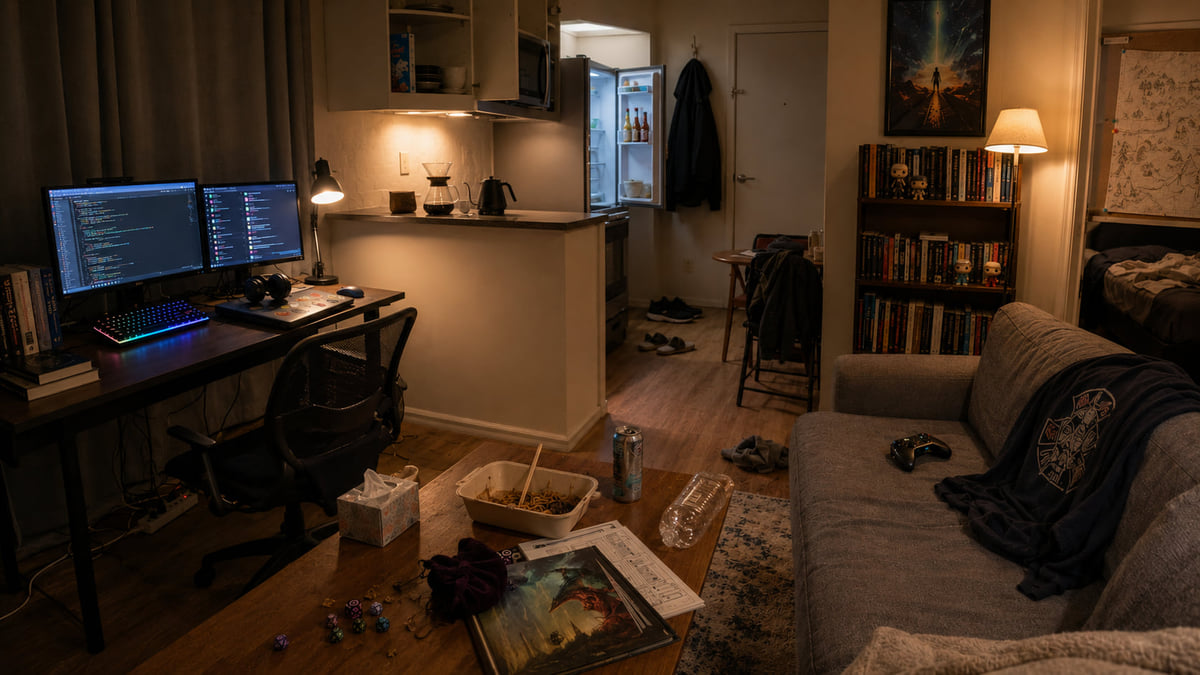
Each of these details is trivial on its own. Together they form a cluster that points toward a specific kind of person. The more scenes you read, the larger your library grows, and the faster you converge on a plausible profile. This is exactly how radiologists learn to spot tumours and how bird-watchers learn to identify species at a distance: repeated exposure, with feedback on accuracy.
The reasoning chain
Holmes rarely draws a single inference. He chains them. "This man's right cuff is frayed, his left is not, therefore he writes extensively with his right hand. The ink stain is the blue-black of a government office. His coat is from a military tailor but worn at the elbows. Therefore: a former officer, now a clerk in Whitehall, who writes reports all day."
Chaining is where most beginners falter. They see a guitar in a corner and conclude "musician." But a guitar alone is weak evidence. A guitar plus calluses on the left fingertips plus a stack of blank sheet music plus a metronome is strong evidence. The chain is what separates a guess from a deduction.
Philosophers call this abductive reasoning: inference to the best explanation. Strictly speaking, Holmes almost never uses pure deduction (moving from a general law to a specific case). He observes specific clues and reasons backward to the explanation that accounts for all of them. Conan Doyle gave it the wrong name, but the method itself is sound.
The practical rule: never stop at one clue. Look for a second that supports or contradicts the first. Then a third. When three independent observations point to the same conclusion, you are probably right. When they contradict each other, you are probably misreading one of them.
The dog that did not bark
In Silver Blaze, Holmes solves the case by noticing something that did not happen: the stable dog did not bark the night the horse vanished. The dog's silence means the intruder was someone the dog knew: the trainer himself.
Absence is one of the most powerful observation tools, and one of the hardest to use. Our brains are wired to process what is present, not what is missing. But in any scene, what should be there and is not can tell you as much as what is there.
A kitchen with a full spice rack but no fresh food in the fridge suggests someone who cooks ambitiously but infrequently. A bookshelf with no fiction suggests a particular personality type. A workspace with two screens but no personal photos suggests either a very private person or a very new one.
When you study a Daily Holmes photograph, train yourself to ask: "What is missing that I would expect to see?" It is an awkward question at first. It becomes natural with repetition.
Common mistakes
Three errors trip up nearly every beginner:
- Confirmation bias. You form an early hypothesis ("this person is a student") and then selectively notice details that support it while ignoring details that contradict it. The fix: actively look for one piece of evidence that would disprove your current theory.
- Single-clue certainty. One detail (a stethoscope, a legal pad, a set of brushes) feels so definitive that you stop looking. But objects travel: a stethoscope can sit on a veterinarian's desk, a parent's shelf, or a Halloween costume pile. Always require at least two supporting clues before committing.
- Ignoring context. A surfboard in a beachfront apartment tells you little. The same surfboard in a landlocked city tells you a lot. Environmental context modifies the weight of every clue. Always read the setting before reading the objects.
How to practise
Holmes practised constantly. Watson frequently caught him conducting experiments in their sitting-room, testing how different chemicals stain fabric or how long a footprint remains visible in various soils. You do not need a chemistry set. You need a feedback loop.
The most effective practice cycle has three steps:
- Study a scene. A photograph, a desk, a room in a cafe. Spend 60 to 90 seconds scanning it deliberately, working through categories: occupation, hobbies, lifestyle, personality, recent activity.
- Write your deduction. Writing forces you to commit. A vague mental impression ("seems like a creative person") becomes a specific claim ("freelance graphic designer, late twenties, recently moved in") when you put it in words.
- Check against reality. In everyday life, you can ask the person (politely). In a daily deduction game, the AI compares your reasoning to the actual facts of the case and tells you what you caught and what you missed.
Run the loop on a live scene
An entryway, seven in the evening

Seven marks in one entryway. Read the scene first, then tap each mark to compare your inference with the detective's. This is the observe, interpret, chain cycle in miniature.
The write-then-check loop is the single most important habit. Without the check, you never learn which of your inferences were lucky guesses and which were genuinely supported. Without the writing, your observations stay too vague to be tested.
From Holmes to the real world
Holmes was fiction, but his method was not invented from nothing. Dr. Joseph Bell's clinical observations were real. Modern professionals use the same skill set: detectives read crime scenes, doctors read patients, intelligence analysts read satellite imagery, and archaeologists read dig sites.
What these experts share is not a high IQ. It is thousands of hours of deliberate observation with feedback. The mental library they build lets them pattern-match faster, notice anomalies sooner, and tolerate ambiguity longer before committing to a conclusion.
You will not develop Holmes-level skill from one article or one puzzle. But you will develop it from a hundred puzzles, a thousand observations, and the habit of writing down what you think and then checking whether you were right. The science of deduction is not a gift. It is a practice.
Frequently asked questions
What is the science of deduction?
It is a method of reasoning Sherlock Holmes describes in A Study in Scarlet: observe details most people overlook, draw on stored knowledge to interpret them, then chain those interpretations into a conclusion about a person or event. Holmes called it a "science" because he believed the process could be studied and taught, not just stumbled upon by gifted individuals.
Did Sherlock Holmes actually use deduction?
Mostly not, by the strict philosophical definition. Holmes typically used abductive reasoning: he observed surprising facts and inferred the best explanation. True deduction moves from a general rule to a specific case ('all doctors carry stethoscopes; this person carries a stethoscope; therefore they are a doctor'). Holmes worked the other way, starting from specific observations and reasoning backward to the most likely explanation.
Can anyone learn to observe like Sherlock Holmes?
Yes. Observation is a trainable skill, not a talent. Psychologists who study perceptual expertise (radiologists, bird-watchers, chess masters) confirm that focused practice with feedback improves what people notice and how fast they notice it. The key ingredients are deliberate attention, a growing mental library of patterns, and regular feedback on whether your interpretations were right.
What is the difference between seeing and observing?
Holmes draws the distinction in A Scandal in Bohemia: 'You see, but you do not observe.' Seeing is passive. Your eyes register the staircase you climb every day. Observing is active. You count the steps, notice which ones creak, note the worn patch where most feet land. The difference is intention: observing means looking with a question in mind.
How can I practise deductive reasoning every day?
Start with any static scene: a co-worker's desk, a cafe table someone just left, or a photograph in a daily deduction game. Ask yourself what the scene tells you about the person who uses it. Write your reasoning down, because writing forces you to commit to an interpretation instead of staying vague. Then check whether you were right. The write-then-check loop is the single most effective practice cycle.
What are the most common mistakes beginners make?
Three stand out. First, jumping to the conclusion before examining the full scene (confirmation bias). Second, treating a single clue as proof rather than as one piece of a pattern. Third, ignoring what is absent: Holmes repeatedly solves cases by noticing what should be there but is not, like the dog that did not bark in Silver Blaze.