
Observation practice needs a repeatable loop: study a scene, commit to an interpretation, then check it against feedback. Here is a structured method you can use without assuming a fixed timetable.
In brief
- Observation practice works best when it is deliberate and includes feedback on what you missed.
- The core drill is the write-then-check loop: study a scene, commit to a written reading, then check it against the facts.
- Experts read clusters and absences, not single objects: a guitar means little, a guitar with worn frets and chord charts means a learner.
When Sherlock Holmes told Watson "You see, but you do not observe," he identified the gap that separates most people from experts in any visually demanding field. Radiologists, crime scene investigators, bird-watchers, and art authenticators all share one skill: they extract more information from the same image than an untrained viewer does. The difference is not sharper eyesight. It is a trained attention system.
This article covers what observation actually is, why feedback matters, and how to build a sustainable daily practice.
What observation is (and is not)
Observation is not photographic memory. Holmes himself says he does not remember everything. He remembers what matters. In A Study in Scarlet, Watson is shocked to learn that Holmes does not know whether the Earth goes around the Sun. Holmes explains that his brain is like an attic: he stocks it carefully with the tools he needs and leaves out the furniture he does not.
Observation, in the Holmesian sense, is selective attention directed by a question. When Holmes enters a room, he is not passively absorbing everything. He is scanning for specific categories: traces of occupation, signs of habit, markers of recent activity, objects out of place. The question shapes what he notices.
This is consistent with modern attention research. Our visual system processes far more information than our conscious mind can handle. What reaches awareness depends on what we are looking for. Observation training, then, is not about seeing more. It is about looking for the right things.
The scan, not the stare
Beginners tend to fixate on the most prominent object in a scene. A large painting, a bright-coloured item, or a human face captures their gaze, and they build their entire interpretation from that single anchor. Trained observers do something different: they scan.
Eye-tracking studies of expert radiologists show that they cover the entire image in a systematic sweep before focusing on any one region. They let the global pattern register first, then zoom into areas that seem anomalous. The technique is called "global-then-local" processing, and it applies directly to reading everyday scenes.
When you open a Daily Holmes photograph, resist the urge to zoom in immediately. Spend the first 10 seconds taking in the whole frame: the room type, the lighting, the level of order or disorder, the colour temperature. These global cues set the context for everything else. A cluttered desk in a sunlit home office tells a different story from the same clutter in a basement.
Categories as search lenses
Holmes worked with implicit categories. Modern observation training makes them explicit. Here are six lenses that work for reading any personal space:
- Occupation. Tools of a trade, professional reading material, uniforms, equipment. Not just what is present but how it is arranged: a neatly organised toolkit suggests a professional; the same tools scattered on a kitchen table suggest a hobbyist.
- Hobbies and interests. Books, instruments, sports gear, craft supplies. Look for depth: a single novel means nothing, but a shelf sorted by author suggests a serious reader.
- Lifestyle markers. Meal remnants, fitness equipment, medication, pet accessories, travel souvenirs. These reveal daily routines.
- Relationships. Photos of people, two sets of dishes, children's art on a fridge, a dog bed. Who else shares this space?
- Recency. A coffee cup still steaming, an open laptop with a visible tab, mail on the counter with a recent postmark. What was this person doing just before the photograph was taken?
- Absence. What should be here but is not? A kitchen with no cooking utensils. A desk with no personal items. An apartment with no art on the walls. Absence reveals as much as presence. Holmes used this constantly.
Running through these six lenses takes about 60 seconds. After a few weeks of practice, the scan becomes automatic.
The cluster principle
A single observation is a guess. Three observations that point in the same direction are evidence. Observation training teaches you to look for clusters.
Suppose you see a stethoscope on a shelf. That could belong to a doctor, a nurse, a veterinarian, a medical student, or someone who bought it as a prop. But add a set of anatomy flashcards, a prescription pad, and a diploma with "M.D." visible, and the cluster converges. The more independent clues point the same way, the more confident the inference.
Clusters also help you spot contradictions, which are often the most interesting part of a scene. A room full of expensive art but with a mattress on the floor. A fitness-obsessed kitchen next to an ashtray. Contradictions mean the scene is more complex than a single label can capture, and that complexity is where the best deductions live.
Building a daily practice
The fastest way to improve observation is the same feedback loop that Holmes relied on: observe, commit to an interpretation, then check.
- Pick a scene. A colleague's desk. A cafe table someone just left. A waiting room. Or a photograph in a daily puzzle.
- Run the six lenses (occupation, hobbies, lifestyle, relationships, recency, absence). Spend 60 to 90 seconds.
- Write your profile. Two to three sentences about who uses this space and what their day looks like. Writing forces precision. "Someone creative" is vague. "A freelance illustrator who works late, eats at the desk, and recently moved in" is testable.
- Check. In real life, you can ask (tactfully). In Daily Holmes, written deductions receive AI feedback, while structured case formats check the answer directly.
Run the loop right now
An entryway, seven in the evening
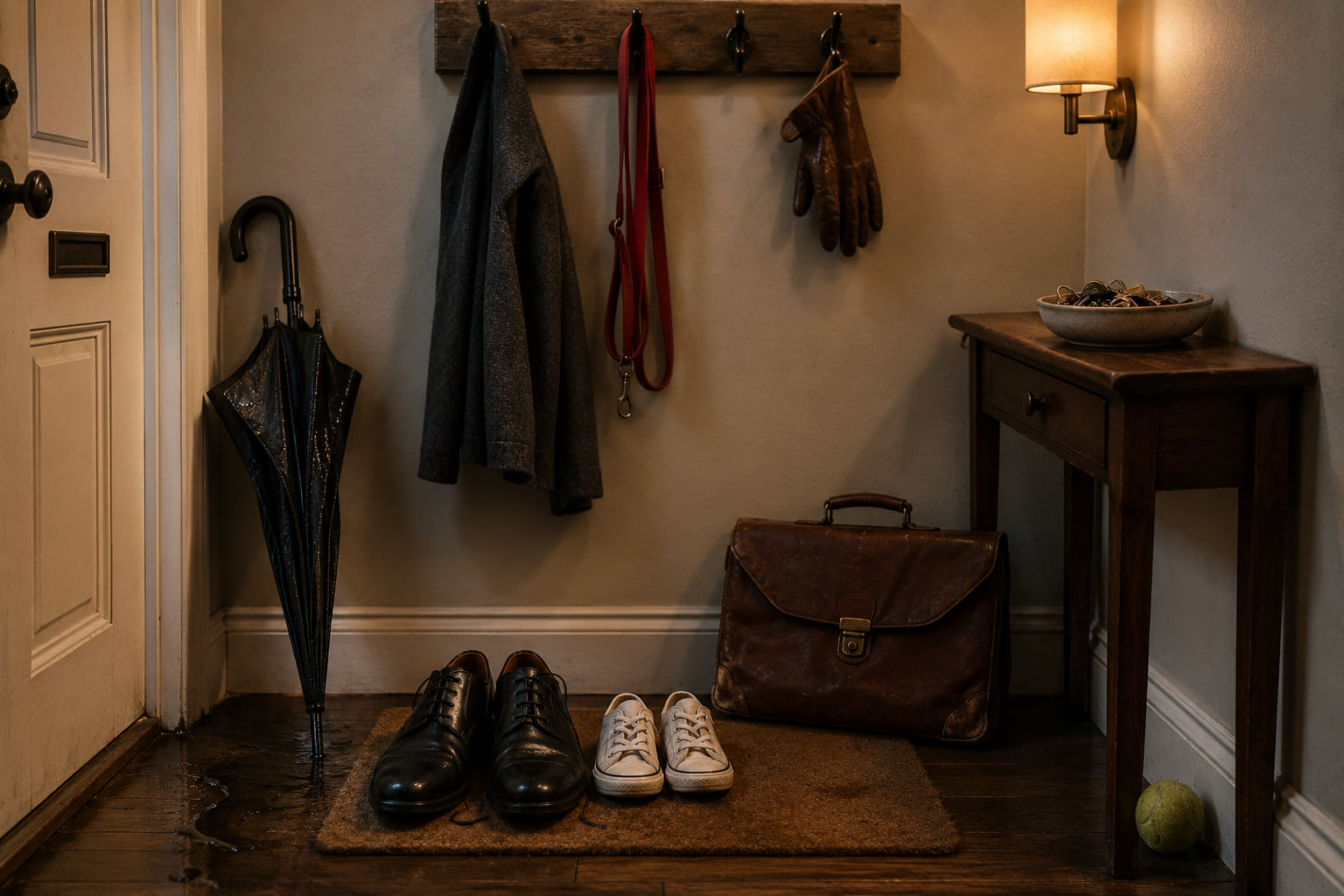
One entryway, seven marks. Read the scene with the six lenses first, then tap each mark to compare your reading with the detective's.
Keep the session short enough to repeat. Each scene adds examples to your mental library of what objects, arrangements, and absences may mean, provided you check your interpretation afterward.
What experts see that you do not (yet)
The gap between a novice and an expert is not attention span. It is vocabulary. An expert birdwatcher does not stare harder at a sparrow. She knows that the stripe above the eye, the shape of the beak, and the flight pattern together identify the species. She has a mental dictionary of visual patterns, and she matches what she sees against it in real time.
The same applies to reading rooms. An experienced observer knows that a particular style of bookshelf comes from a particular store and price range, that certain spice combinations suggest a specific cuisine, that a row of identical notebooks with dates on the spines usually belongs to a journaler. This vocabulary grows only through exposure. There is no shortcut. But there is a pleasant one: every scene you study makes the next scene easier.
How to Be More Observant Like Sherlock Holmes
The canon gives us the clearest picture of observation as a habit rather than a gift. In A Scandal in Bohemia, Holmes asks Watson how many steps lead up from the hall to their Baker Street sitting room. Watson has climbed them hundreds of times and cannot say. Seventeen, Holmes tells him: "You have not observed. And yet you have seen." The eyes did their job. The attention was never engaged, because Watson never expected to be asked.
Turn that exchange into a drill. Once a day, quiz yourself on a space you pass through constantly: how many windows face the street from your office, what is printed on the mug you drank from this morning, which way the door of your local cafe swings. Then go and check. Being wrong is the point. The small sting of a missed answer is what recalibrates attention.
A second Holmes habit is reading people from small physical evidence. In A Study in Scarlet he claims a person's trade shows in the fingernails, the coat sleeve, the boots, the knees of the trousers. The drill: pick one stranger a day and one detail only, a paint fleck on a wrist, a bicycle clip still on an ankle, calluses on the fingertips of the left hand. Form a single testable inference and hold it loosely.
A third habit is restraint. "It is a capital mistake to theorize before one has data," Holmes warns in the same conversation as the staircase lesson. So before interpreting any scene, spend thirty seconds naming only what is literally there. For the reasoning system these habits feed, read our guide to thinking like Sherlock Holmes. For a proving ground, today's case gives you a visual scene and a focused daily brief.
Frequently asked questions
Can observation skills be trained?
Yes. Research on perceptual expertise shows that radiologists, bird-watchers, and chess masters all develop superior observation through deliberate practice with feedback. The skill transfers: people trained to notice details in one domain become faster at spotting anomalies in others.
How long does it take to improve observation skills?
There is no universal timetable. Progress depends on the task, the quality of feedback, and how consistently you practise. A short repeatable session is more useful than a schedule you cannot maintain.
What is the best daily exercise for observation?
Study a scene (a room, a desk, a photograph), write down what you think it reveals about the person who uses it, then check your answer. The write-then-check loop builds pattern recognition faster than passive looking because it forces you to commit to an interpretation.
What do experts notice that beginners miss?
Experts notice relationships between objects, not just individual objects. A beginner sees a guitar. An expert sees a guitar with worn frets, a capo on the third fret, and a stack of chord charts, and interprets the cluster as a learning guitarist rather than a performer. Experts also notice absence: what should be there but is not.
Does observation training help in everyday life?
It does. People who practise deliberate observation report better recall of conversations, faster recognition of social cues, improved situational awareness, and stronger performance in visually demanding work (design, medicine, security). The underlying skill is attention management, which applies everywhere.