
Kim's Game is a classic observation and memory exercise: study a group of objects for a short time, cover them, then recall every item in as much detail as you can. The name comes from a spy novel.
In brief
- Kim's Game trains observation by testing recall: study a tray of objects, cover it, then reproduce every detail from memory.
- The exercise comes from Kipling's 1901 novel Kim and still runs in military and sniper training under the initials KIMS.
- A daily photograph puzzle is a single-player Kim's Game with a built-in answer key.
In Rudyard Kipling's 1901 novel Kim, an orphan boy in colonial India is recruited into the intelligence service, and part of his training happens in the back room of a jewel merchant named Lurgan Sahib. Lurgan drops a handful of stones on a tray, lets Kim look for a moment, throws a cloth over them, and says: now tell me what was there. The first time, a Hindu boy who has been doing this for years beats Kim easily, reciting not just the count of stones but their colours, flaws, and settings. Kim is humiliated. Then he practises, and he gets frighteningly good.
That scene gave its name to one of the oldest and most durable observation exercises in existence. Robert Baden-Powell, who had run military scouts before he founded the Scouting movement, put it into Scouting for Boys in 1908 and called it Kim's Game. More than a century later, versions of it are still used to train soldiers, snipers, and observers, usually under the initials KIMS. The exercise has survived that long for a simple reason: it works, and it works on a principle most attention advice ignores.
Why a memory game trains observation
The trick of Kim's Game is that it does not test looking. It tests recall, and by doing so it changes how you look in the first place. When you know a cloth is about to cover the tray and you will be asked to reproduce it, you stop drifting across the objects and start encoding them: naming, grouping, fixing them in place. Psychologists would say you are forced to move information from fleeting sensory memory into something you can retrieve. Passive looking never does this, which is why you can stare at something for a minute and remember almost nothing about it.
It also delivers the one thing observation practice usually lacks: feedback. When the cloth comes off, you find out precisely which stones you missed. That gap between what you recalled and what was actually there is the entire lesson. It tells your attention where it failed, so it can aim better next time. This is the same reason a deliberate practice loop beats simply trying to be more observant.
How to play it
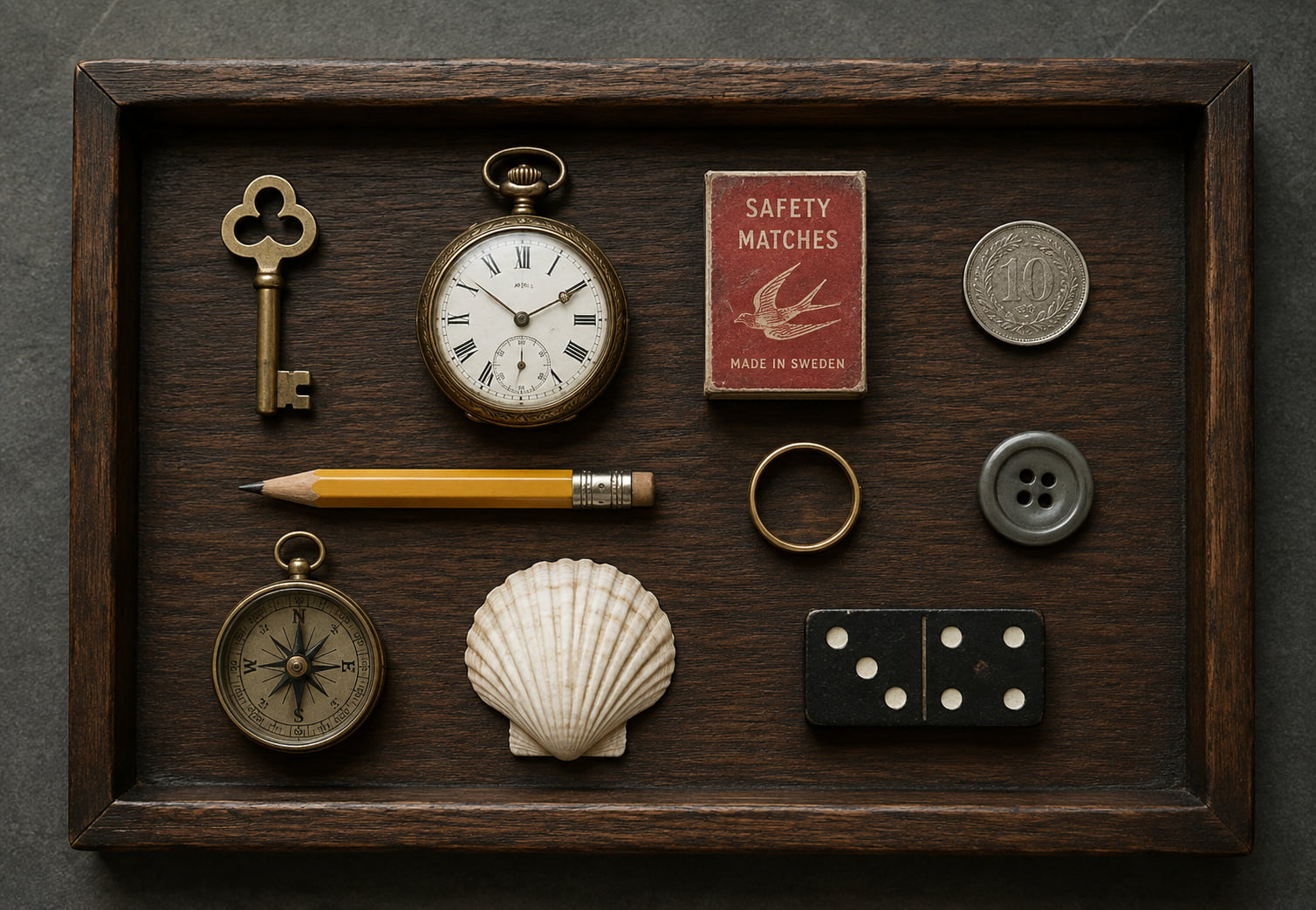
The classic group version needs nothing but a tray, a cloth, and a handful of small objects. One person arranges fifteen to twenty unrelated items, a coin, a key, a button, a matchbox, a shoelace, and gives everyone one minute to study them. The tray is covered, and each player writes down everything they can recall. Scoring is simple: one point per correct item, and in the stricter versions you lose a point for anything you invent, which punishes the tempting habit of filling gaps with plausible guesses.
The military variant raises the difficulty in two ways worth stealing. First, it delays the recall: study the tray now, write it up an hour later, after other tasks have crowded your memory. Second, it rewards specificity. "A knife" earns less than "a folding knife with a bone handle and a chipped tip." The point is not to remember that something was there, but to remember it well enough to describe it to someone who was not.
Playing it alone, and playing it with photographs
You do not need a group or a tray. A photograph is a ready-made Kim's Game: study it for thirty seconds, look away, and write down everything you can recall, then check yourself against the image. Because a photo holds far more than fifteen objects, it also lets you practise the harder skill of grouping, reading a scene as clusters of related detail rather than a heap of items.
There is a second photographic variant that trains something Kim's tray cannot: change detection. Show a scene, then show it again with something altered, and find what moved. This is the logic behind spot-the-difference, and it is a genuinely different muscle, the one that notices the coat that was on the chair a moment ago and is now gone. It is also the reason the dog that did not bark, in the Holmes story Silver Blaze, is such a satisfying clue: the observer noticed an absence by comparing what should have happened with what did.
A daily version with a built-in answer key
The weakness of playing Kim's Game by yourself is discipline. It is easy to skip the checking step, or to go easy on your own scoring, and without honest feedback the exercise loses its power. This is where a structured daily puzzle helps: it supplies the scene, the question, and the answer, and it does not let you off the hook.
Some Daily Holmes cases work like a modern, single-player Kim's Game with the reasoning stakes turned up. You study a visual scene, commit to an answer, and the reveal shows which details mattered. Some formats lean directly on the tray-and-cloth tradition, asking you to read a scene or catch what changed between two frames. Lurgan Sahib would have approved. The stones are just photographs now, and the tray arrives every morning.
Frequently asked questions
What is Kim's Game?
Kim's Game is an observation and memory exercise in which you study a group of objects for a short time, they are covered or removed, and you try to recall them in as much detail as possible. It takes its name from Rudyard Kipling's 1901 novel Kim, where a jewel merchant uses the game to train the boy Kim as an intelligence agent.
Where does the name come from?
From the novel Kim (1901) by Rudyard Kipling. A character named Lurgan Sahib repeatedly shows Kim a tray of mixed jewels and stones for a moment, then covers it and asks him to describe everything on it. Kim loses to a trained Hindu boy at first, then improves with practice. Robert Baden-Powell adapted the exercise for scouts in Scouting for Boys in 1908 and named it after the character.
Do the military still use Kim's Game?
Yes. Observation and memory drills modelled on it are used in military and sniper training, often under the label KIMS, sometimes expanded as "Keep In Memory System." Trainees study a tray of unrelated items, then record them from memory, sometimes hours later, to build the recall an observer needs in the field.
How is Kim's Game different from just looking at things?
It forces encoding and recall, not passive viewing. Because you know you will be tested, you look with intent, and because you have to reproduce the details later, you find out exactly what you failed to register. Passive looking never closes that loop, which is why it does not improve your observation.
Can I play Kim's Game alone?
Yes. Photographs make a good solo version: study an image, look away, and write down everything you can recall, then check. A daily visual deduction puzzle is effectively a modern, single-player Kim's Game with a built-in answer key.