
The best games like Murdle are Clues by Sam and Puzzle Baron for pure logic-grid deduction, Daily Holmes for reading a scene instead of a grid, and Mystery-o-matic or Daily Detective for a fresh murder mystery every day.
In brief
- Clues by Sam and Puzzle Baron are the closest games like Murdle for pure logic-grid deduction.
- Daily Holmes swaps the grid for a visual scene: you extract the clues before you reason from them.
- Mystery-o-matic and Daily Detective serve a fresh murder mystery every day for solvers who want the whodunnit itself.
That is the short answer. The longer one depends on what you actually like about Murdle: the click of a grid resolving, the authored voice, or the ritual of a small crime solved before coffee. This guide groups the alternatives by those three pleasures. Full disclosure: we make Daily Holmes. This is a genuine comparison, and where a competitor is the better answer for your taste, we say so.
What makes Murdle hard to replace
Murdle is a daily logic-grid murder mystery by G. T. Karber, running free at murdle.com since 2022. Each case hands you a short crime, a cast of suspects, weapons, and locations, and a grid to fill: who, how, where, and on ambitious days why. You cross-reference the clues, eliminate the impossible, and commit to the one arrangement that survives.
The mechanics are classic logic-grid; the voice is what turned a puzzle into a franchise. The first book collection, Murdle: Volume 1, was the UK's Christmas number one bestseller in 2023 and Waterstones' Gift of the Year, making Karber only the third non-British writer to top that chart, after Michelle Obama and Dan Brown. The series has since grown to multiple volumes and a junior edition.
This also explains why people go looking for alternatives. A practiced solver clears the daily Murdle in minutes, and then the day's detection is over. The books fix the volume problem, but a book on the shelf is not a fresh case waiting at midnight. What most searchers want is a second daily.
So be honest with yourself before the list: nothing below is Murdle with new paint. Each alternative keeps one of Murdle's pleasures and trades away another. Pick by the pleasure you would miss most.
The honest frame
Nothing on this list is Murdle with new paint. Each alternative keeps one of its pleasures and trades away another.
If the logic grid is the pleasure
These are the games for solvers who love the discipline itself: constraints, eliminations, and the moment the last cell locks into place.
Clues by Sam
What it is: A daily grid of twenty suspects, five rows by four columns. Everyone is either criminal or innocent, and everyone tells the truth, even the criminals. You may only mark a suspect when the logic proves it; the game rejects guesses outright.
Strength: The closest thing to Murdle's rigor in a daily format. The no-guessing rule enforces real deduction, and puzzles get harder through the week. Built in Finland by Johannes Ahvenniemi, launched in May 2025, and a breakout among that year's daily puzzles.
Limitation: Plain presentation and no narrative beyond the grid. One free puzzle per day Monday through Saturday; Sunday's puzzle requires a login, and extra puzzle packs are paid.
Puzzle Baron's Logic Puzzles
What it is: The old guard: classic logic grids with categories, options, and clue lists, playable online or printable. Over 25,000 puzzles, free, with no account required.
Strength: Volume and pace. When one a day is not enough, this is the deep well, with timed solving, monthly competitions, and a hall of fame for registered players.
Limitation: No murder, no story, no voice. The clue sets are procedurally assembled, and after the tenth in a row they can feel like arithmetic. Ads run unless you pay for the premium tier.
Deductionary
What it is: A small single-page daily logic puzzle with an archive, rankings, and an optional login for streaks.
Strength: Quiet and quick. A no-frills daily for solvers who want a second, lighter deduction alongside the main event.
Limitation: Minimal presentation and a tiny community. It is a palate cleanser, not a main course.
If the scene is the pleasure
Some Murdle players realize the part they love is not the grid at all. It is the reading: the moment a detail gives someone away. Murdle extracts the clues for you and hands them over as tidy statements, each one true and relevant. Real detection is messier: a scene does not label its evidence, and half the work is deciding which details matter. There is a daily game that makes you do the extracting.
Daily Holmes
What it is: One visual scene case, published every midnight UTC. You read what is present and missing, then respond in the day's format. Written deductions receive AI feedback; clue hunts, timelines, matching, and other structured formats use direct checks. Free. No signup to play today's case.
Strength: It trains the half of detection Murdle skips: turning a raw scene into clues before anyone reasons about them. On written cases, the feedback separates supported observations from guesses.
Limitation: AI feedback on a written argument is judgment, not arithmetic. If what you love about Murdle is the certainty of a grid resolving to exactly one answer, choose one of Daily Holmes's structured cases or stay with the grid games.
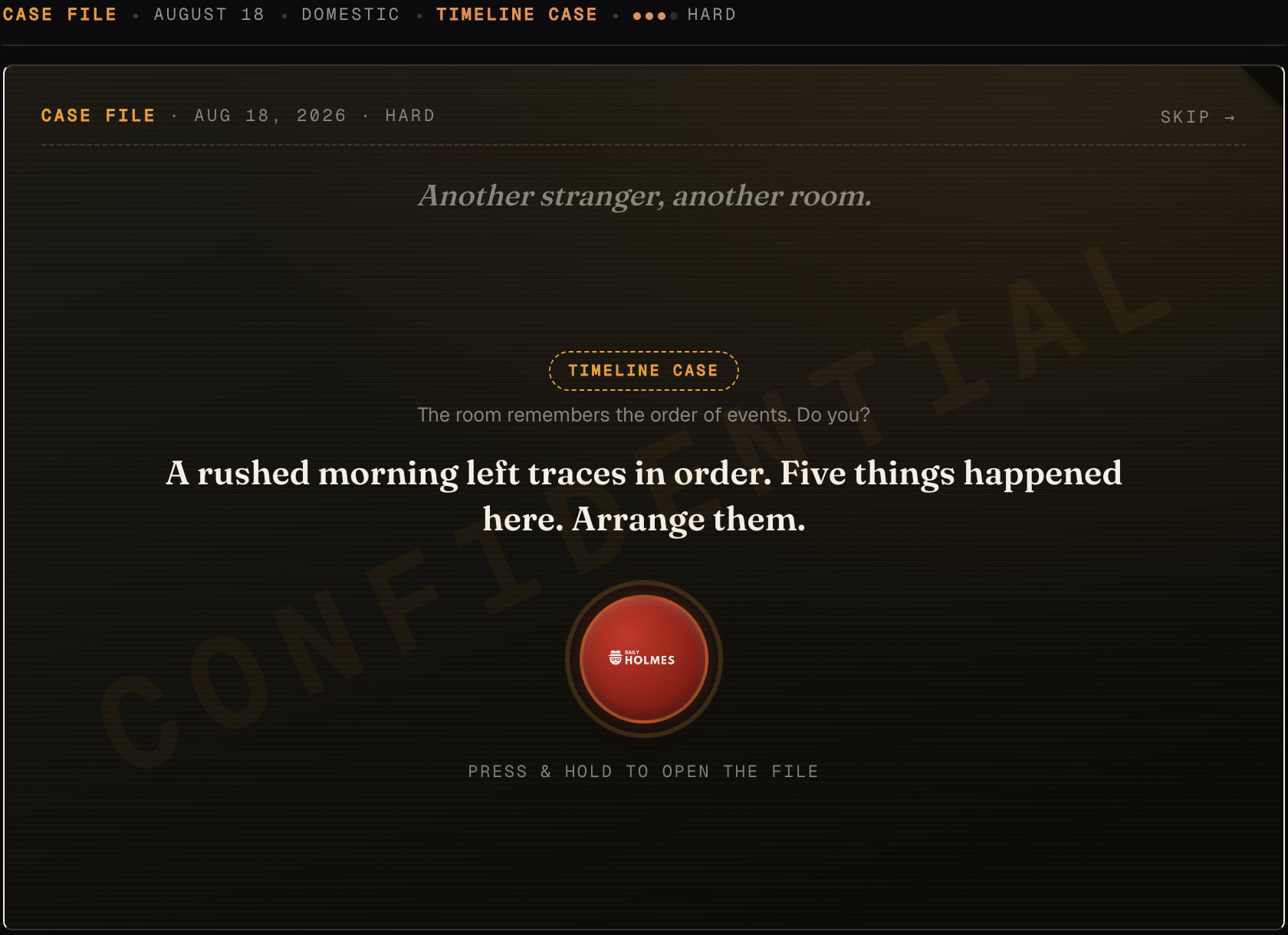
If that appeals, the method behind it is learnable. Start with the science of deduction, then the practical walkthrough in visual deduction 101. For a direct grid comparison, see Murdle vs Clues by Sam.
If the murder is the pleasure
Maybe what you want is simply a fresh whodunnit with your coffee: a body, a handful of suspects, and a culprit named before the toast goes cold. Two small sites serve exactly that.
Mystery-o-matic
What it is: An open-source generator that builds a new murder every day: three suspects, a set of connected rooms, movements in fifteen-minute steps, and a stack of statements. You reconstruct the timetable to name the killer, the time, and the weapon, usually in under five minutes.
Strength: Pure mechanism, endlessly new, and transparent: the generator's code is public on GitHub. The timetable logic scratches the same alibi-checking itch as Murdle's harder days.
Limitation: Generated prose has no authored wit, and the same three suspects return each morning. It is a scheduling proof more than a story.
Daily Detective
What it is: A free daily noir whodunnit: a new case every 24 hours, solved by reading the scene, weighing alibis, and naming the culprit.
Strength: A quick narrative mystery in the daily slot, with logic puzzles on the side. If Mystery-o-matic is too mechanical for you, this leans the other way.
Limitation: A young, small site. Expect lighter puzzles and less polish than Murdle's grid, and none of the book-fed community around it.
How this list was made
Every game here was checked directly before writing: we visited each site, confirmed it is live and free to start, and verified claims about creators, launch dates, and mechanics against the sites themselves and independent coverage. No affiliate links, no paid placement. Where a weakness would matter to a Murdle player, we named it, including our own.
Building a morning rotation
Most daily solvers settle into a rotation of two or three games rather than one replacement. A sensible split by skill:
- Constraint logic: keep Murdle, or add Clues by Sam for a stricter grid with no guessing allowed.
- Observation and inference: Daily Holmes, for reading evidence out of a photograph before you reason about it.
- Alibi reconstruction: Mystery-o-matic, for timetable work in five minutes.
- Overflow: Puzzle Baron, for the days when one puzzle was never going to be enough.
The games train different muscles, and they stack well precisely because of it. Keep the whole rotation under fifteen minutes and it stays a ritual instead of a chore, which is the quiet reason daily games outlast the apps that ask for an hour.
For a wider survey of the whole field, including games outside the murder genre, see our list of deduction games online. And if you want to sharpen the reasoning before tomorrow's case, try the deductive reasoning exercises alongside observation skills training.
Ready to practise?
A new visual case lands every morning. Study the scene and solve it in the day's format. Written deductions receive AI feedback; structured modes check your answer directly.
Play today's caseFrequently asked questions
Is Murdle free?
Yes. The daily case at murdle.com is free to play in a browser, with a built-in tutorial and hints. The money side of Murdle is the book series and merchandise, which are optional. The daily puzzle itself has no paywall.
Are the Murdle books the same as the website?
No. The books are standalone collections written for print, in the same grid format. Murdle: Volume 1 alone holds 100 mysteries graded from Elementary to Impossible, with codes and maps the website does not use. The site's daily puzzle is not pulled from the books, so you can enjoy both without spoiling either.
What daily games are like Murdle but with photographs?
Daily Holmes. Every midnight UTC it publishes a new visual scene case. The interaction varies from written deductions with AI feedback to structured modes such as clue hunts, timelines, and matching. It is free, with no signup needed to play today's case.
What is the closest free alternative to Murdle?
Clues by Sam. It keeps Murdle's core discipline, deduction with no guessing allowed, in a daily grid of twenty suspects, free Monday through Saturday. If you want the same morning slot to train a different skill, Daily Holmes swaps the logic grid for a visual scene and varied case formats.
Who created Murdle?
G. T. Karber, an American mystery writer. The website launched in 2022, and the first book collection followed in 2023 and became the UK's Christmas number one bestseller that year. The series has since grown to multiple volumes plus Murdle, Jr. for younger solvers.
Can I play more than one Murdle-style puzzle a day?
Yes. Puzzle Baron's logic puzzle site holds more than 25,000 classic logic grids you can play or print at any pace, free without an account. Clues by Sam sells extra puzzle packs beyond its daily, and the Murdle books exist for exactly this appetite.