
Murdle is the daily with a voice: an authored murder, a logic grid, and exactly one provable answer. Clues by Sam is the daily with a spine: it refuses any move you cannot prove. Most solvers should play both, and the table below shows why.
In brief
- Murdle is the authored daily: a witty murder mystery, a logic grid, and exactly one provable answer.
- Clues by Sam enforces pure proof: it rejects any move you cannot justify, and difficulty climbs Monday to Saturday.
- Daily Holmes takes a third path: a visual scene, unlabeled evidence, and a mix of written and structured case formats.
The two games are compared constantly because they sit at the top of the same small genre, the daily deduction puzzle, and they represent its two philosophies. This page puts them side by side, then places the rest of the field around them, including the game we make, Daily Holmes, which competes for the same morning and takes a third path entirely.
The comparison at a glance
| Murdle | Clues by Sam | Daily Holmes | Deductionary | |
|---|---|---|---|---|
| New puzzle | Every day since 2022 | Every day since May 2025 | Every midnight UTC | Every day |
| What you read | A short crime story and a logic grid | Twenty portraits and their testimony | A visual scene and a case brief | A compact logic puzzle |
| What you deduce | Who, how, and where | Who is criminal, who is innocent | Varies by the day's format | The day's solution |
| Guessing | Nothing stops it; discipline is yours | Rejected; only provable moves | Written reasoning is reviewed; structured answers are checked | Up to you |
| One exact answer | Yes | Yes | Depends on the format | Yes |
| Difficulty rhythm | Steady, with harder specials | Climbs Monday to Saturday | Varies by format, fifteen in rotation | Not stated |
| Time on a normal day | 5 to 15 minutes | 5 to 20 minutes | About 3 minutes | A few minutes |
| Free tier | The daily, free | Monday to Saturday free | The daily case, free | Free |
| Beyond the daily | Bestselling book series | Paid puzzle packs, Sunday login | Archive and a premium tier | Archive and rankings |
Where Murdle wins
Craft and company. G. T. Karber has published a fresh case every day since 2022 with a light, macabre narration that makes each grid feel like a story rather than an exercise, and the formula proved sturdy enough to become a bestselling book series, including the UK's Christmas number one in 2023. The clue writing is fair, the difficulty curve is generous to newcomers, and on ambitious days the grid stretches to motive. If you want your logic dressed in fiction, Murdle is the standard the genre measures itself against.
Where Clues by Sam wins
Rigor. The game, built by a small Finnish studio and launched in May 2025, is designed around a single uncompromising idea: you advance only on proof. Twenty faces, each criminal or innocent, everyone telling the truth, and an interface that rejects any mark you cannot justify from what you already know. Its instructions promise that there is always a logical next choice, and a solver stands behind the promise. The difficulty climb from a gentle Monday to a punishing Saturday gives the week a shape Murdle does not have. If what you want is the discipline itself, Clues by Sam enforces what every other logic game merely hopes for.
What neither of them trains
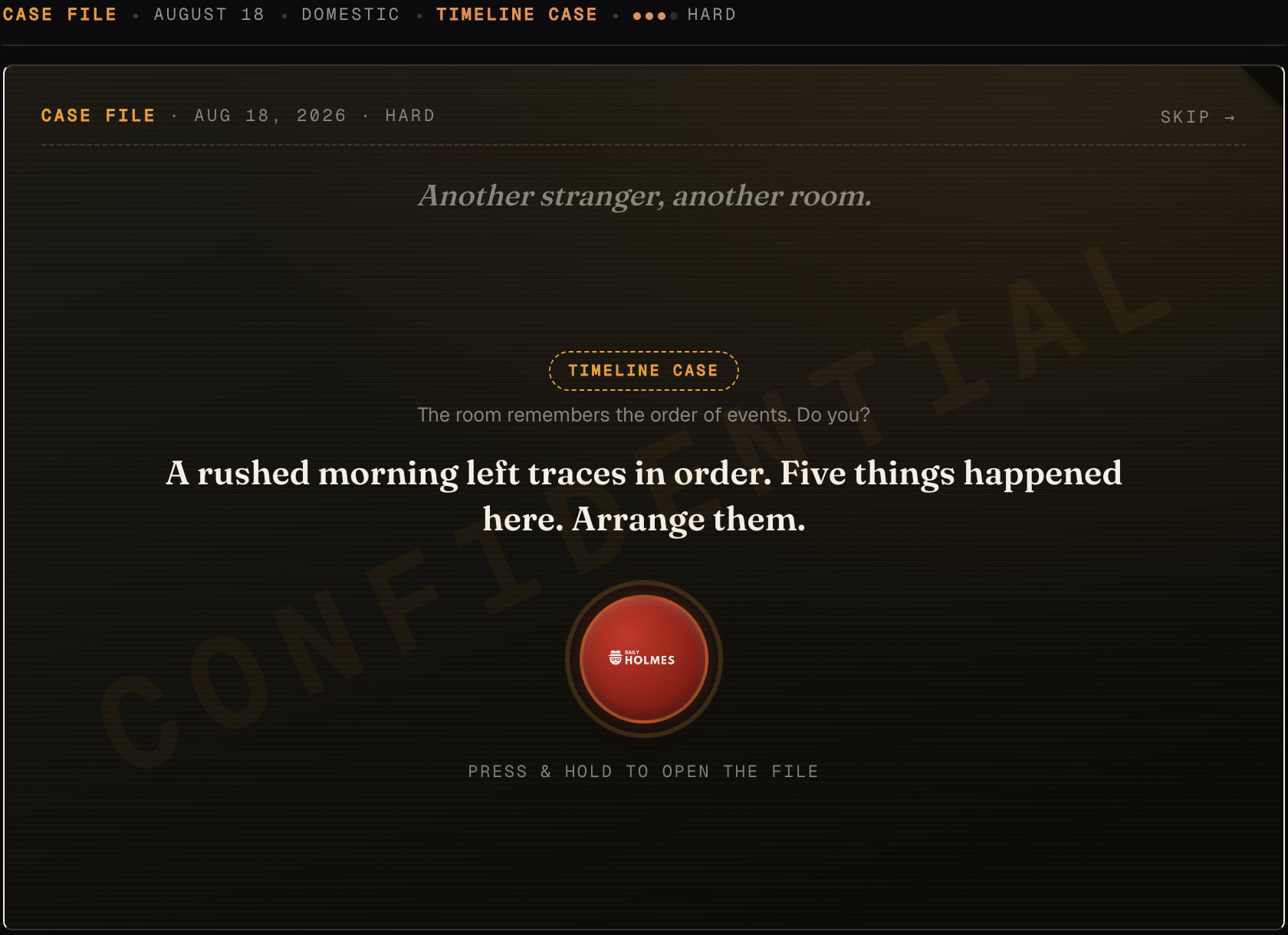
Both games hand you the evidence pre-labeled. Every clue arrives as a true, relevant statement; your job begins after the observing is done. That is precisely the part Daily Holmes makes you do yourself: a visual scene, nothing labeled, and the work is deciding which details are evidence at all before you answer. Written deductions receive AI feedback, while structured formats use exact checks. The open-ended cases are closer to abduction than deduction. If the grids ever start to feel like arithmetic, that is the muscle waiting to be worked. And if you simply want a second small logic daily alongside the big two, Deductionary is a quiet single-page option that respects your time.
The verdict
Play Murdle for the author, Clues by Sam for the enforcement, and rotate in a scene-reading game when you notice you have stopped observing and started computing. A workable morning: one grid for proof, one photograph for judgment, done before the coffee cools. For the wider field beyond these three, see our survey of the best deduction games online or the deeper dives on games like Murdle and games like Clues by Sam.
A workable morning
One grid for proof, one photograph for judgment, done before the coffee cools.
Ready to practise?
A new visual case lands every morning. Study the scene and solve it in the day's format. Written deductions receive AI feedback; structured modes check your answer directly.
Play today's caseFrequently asked questions
Is Murdle or Clues by Sam better?
It depends on which pleasure you want. Murdle has an authored voice and a story around every grid; Clues by Sam enforces pure proof and will not let you guess. Both take minutes and both are free daily, so most solvers simply play both.
Are Murdle and Clues by Sam free?
Both dailies are free in any browser. Murdle publishes a free case every day and sells book collections separately. Clues by Sam is free Monday through Saturday; the Sunday puzzle sits behind a login, and extra puzzle packs are paid.
What is the main difference between Murdle and Clues by Sam?
Enforcement. Murdle hands you clues and trusts you to reason; nothing stops a hopeful pencil mark. Clues by Sam rejects any mark you cannot yet prove, so every solve is a chain of certainties. One trusts your discipline, the other supplies it.
Is there a daily deduction game that uses photographs instead of grids?
Daily Holmes. One visual scene case arrives at midnight UTC, and you extract evidence from the image rather than a supplied clue list. The response format varies between written deductions and structured interactions. Free. No signup to play today's case.
Can I play Murdle and Clues by Sam on the same day?
Comfortably. Each takes five to twenty minutes depending on the day. Many solvers run a morning rotation: one grid game for proof, then a scene-reading game for judgment, and the two skills sharpen each other.