
The best deduction game online depends on what you want to deduce. Daily Holmes uses visual scenes, Murdle and Clues by Sam use logic grids, and NYT Connections uses word categories. Each offers a free daily puzzle in a browser; social deduction games are a separate, group-based category.
In brief
- Deduction games online fall into four families: scene, grid, word, and social deduction.
- Daily Holmes covers scene deduction, Murdle and Clues by Sam cover logic grids, and NYT Connections covers word categories, all free in a browser.
- Social deduction games like Among Us need a live group and an app, so the daily browser habit belongs to the solo families.
Search for deduction games online and the results mix solo browser puzzles, downloadable games, and social deduction for groups. This guide separates those formats and compares representative games by what each one makes you deduce, whether it runs in a browser, and where it falls short.
The four families, at a glance
- Scene deduction: you read a photograph or an environment and infer facts about a person or an event. Daily Holmes.
- Grid deduction: you eliminate possibilities until exactly one solution survives. Murdle, Clues by Sam, Deductionary.
- Word and category deduction: you uncover hidden groupings from ambiguous evidence. NYT Connections.
- Social deduction: you read live human behavior to find the liar. Among Us and its family, mostly outside the browser.
The families are not interchangeable. Each trains a different muscle, and most players end up loyal to one or two. Here is what each family asks of you.
Deducing from a scene
This is the oldest form of the craft: a room, a stranger, and the question of what one says about the other. Scene deduction gives you no list of suspects and no grid to fill. It gives you evidence in place and asks what you notice.
Daily Holmes
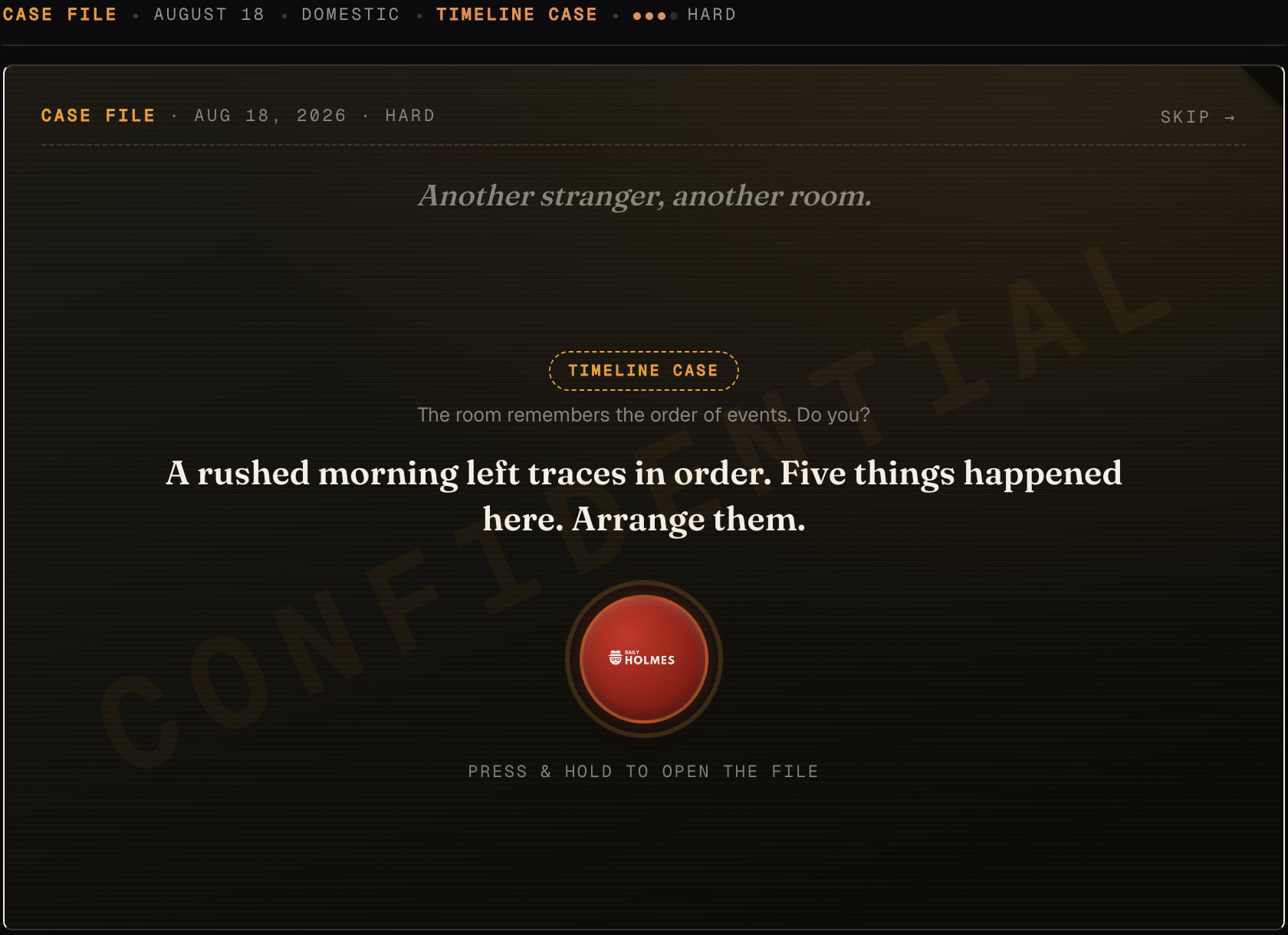
What it is: One visual scene case, published at midnight UTC. The format varies: you might write a deduction, find an object that does not belong, identify a false statement, or put events in order. Written deductions receive AI feedback; structured formats are checked deterministically.
Strength: The clues live inside the scene rather than in a supplied clue list, so observation comes before elimination. The daily case is free and needs no signup to play.
Limitation: AI feedback on a written argument is a judgment rather than a formal proof, so it can miss a valid interpretation. Structured modes have exact checks, but players who only want logic grids may prefer Murdle or Clues by Sam.
Deducing from a logic grid
Grid deduction is deduction in the strict sense: from the given premises, exactly one conclusion follows, and the game can prove it. If you like certainty, this is your room.
Murdle
What it is: A daily murder mystery by G. T. Karber, running since 2022. Each case hands you suspects, weapons, locations, and motives; you cross-reference the clues in a logic grid until only one combination of who, how, where, and why remains. Free in the browser.
Strength: Clean, provable solutions with real wit in the writing. The puzzles grew into a bestselling book series, including a UK Christmas number one in 2023, and the craft shows in every clue.
Limitation: Everything you need is stated up front. Murdle exercises elimination, not observation: you never have to notice anything, only combine what you are told.
Clues by Sam
What it is: Twenty people in a grid of portraits, launched in May 2025 by Johannes Ahvenniemi. Each suspect's testimony unlocks as you mark their neighbors criminal or innocent, and every mark must be provable from what you already know. Guessing is not an option the interface offers. Difficulty climbs through the week.
Strength: The no-guessing rule is the whole game. Holding your inference until it is airtight is the rarest discipline a puzzle can teach, and this one enforces it mechanically.
Limitation: The reasoning is purely verbal logic in a plain interface. Your eyes are never asked to do any work, and late-week puzzles can turn into long chains of case-splitting.
Deductionary, a small, quiet daily logic puzzle, rounds out the family. If the grid is your favorite room, we keep two dedicated maps: games like Murdle and games like Clues by Sam. Our Murdle vs Clues by Sam comparison puts their guessing rules and difficulty rhythms side by side.
Deducing from words and categories
Connections (NYT)
What it is: Sixteen words hiding four groups of four, from The New York Times. You commit to one group at a time, and four wrong guesses ends the day. Free to play, with color-coded difficulty from yellow (easiest) to purple (cruelest).
Strength: The best red herrings in daily puzzling. Words that obviously belong together often do not, and the game punishes the fast, confident read. The habit it builds, withholding judgment until the evidence settles, transfers everywhere.
Limitation: It is closer to association than to deduction. You are recognizing patterns and testing hypotheses against a vocabulary, not reasoning from evidence to a conclusion about the world.
Social deduction, the live variety
Social deduction inverts the whole format: the evidence is other people. Among Us, by Innersloth, remains the standard. Four to fifteen players, crewmates and impostors, free on Android and iOS and $4.99 on PC and consoles. It is a genuinely great game, and it is not a browser ritual: rounds need a live group, and the deduction runs on behavior, who voted how, who was where, who is talking a little too much, rather than on fixed evidence you can stare at. We found no browser version we would vouch for, so this family lives on your phone or at your table. If what you want is the daily solo habit, stay with the families above and save the impostors for game night.
Deduction or trivia? A quick test
Before adopting any daily, ask one question: could a clear-thinking stranger with no special knowledge solve it? Framed shows you movie stills; if you have seen the film you win, and if you have not, no amount of reasoning helps. That is recall, and it makes a fine game, but it is trivia. TimeGuessr sits between the camps: you place a photograph in time and on the map, and while memory helps, you can genuinely reason your way in from car models, signage, and architecture. Deduction proper keeps everything you need inside the puzzle and asks you to build the conclusion yourself. The reasoning involved has formal names, and the one Holmes actually used is not the one he is famous for: deduction vs. induction vs. abduction sorts them out.
The test
Could a clear-thinking stranger with no special knowledge solve it? If yes, it is deduction. If not, it is trivia.
How to pick your daily
- You want detective work: play Daily Holmes. Reading a visual scene for evidence puts observation before the answer.
- You want provable certainty: Murdle for narrative and variety, Clues by Sam for pure rigor.
- You want a fast word workout: Connections. Three minutes, sharp edges.
- You want a room full of accusations: Among Us, with people you can watch squirm.
Many players pair one grid game with one scene game: the grid trains elimination, the scene trains noticing, and neither substitutes for the other. If you want full reviews of the field before committing, our guide to the best daily deduction games goes game by game. For Holmes-themed choices, see the Sherlock Holmes games that are actually worth playing. If you want the skill without the scoreboard, start with ten deductive reasoning exercises or our observation training guide.
Ready to practise?
A new visual case lands every morning. Study the scene and solve it in the day's format. Written deductions receive AI feedback; structured modes check your answer directly.
Play today's caseFrequently asked questions
What are the best deduction games to play online?
For visual scene deduction, try Daily Holmes. For logic grids, try Murdle or Clues by Sam. NYT Connections covers word categories. These four have a free browser-playable daily puzzle. Social deduction games such as Among Us are built for live groups and usually require an app.
Are there free deduction games that need no download?
Yes. Daily Holmes, Murdle, Clues by Sam, Deductionary, and NYT Connections all run in an ordinary browser tab. Daily Holmes is free with no signup to play today's case. The others are free as well, with optional paid extras such as puzzle packs or books.
What is the difference between a deduction game and a trivia game?
Trivia rewards what you already know: Framed, for instance, is recall of films you have seen. A deduction game puts everything you need inside the puzzle and rewards reasoning from that evidence to a conclusion. A stranger with no special knowledge can, in principle, solve a deduction game perfectly.
Can you play social deduction games like Among Us in a browser?
Not officially. Among Us is free on Android and iOS and costs $4.99 on PC and consoles. Browser deduction is dominated by solo daily puzzles. Social deduction needs live players, so it lives in apps and at tables rather than in a browser tab.
How long does a daily deduction game take?
It depends on the format and difficulty. A short word or grid puzzle may take a few minutes, while a harder grid or open-ended scene can take longer. Daily Holmes is designed around a roughly three-minute daily case, but there is no penalty for taking your time.